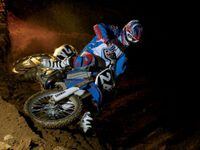
Do you ever wonder how aftermarket companies come up with better settings for your scoot? Every time I go to the track I see bikes that have been fully dressed with suspension, motor work, triple clamps-you name it, and the bikes have it! Big modifications such as these aren't cheap, and with today's bikes near perfect in stock trim, it's getting extremely tough for hop-up companies to improve on the original. I have been asked many times if cost is worth the performance changes and gains. Let's just say it is worth it if the modifications are done right, but it's just as easy to tune your bike into an unridable nightmare.I spent time with the Pro Circuit crew as they developed settings for the 2005 Yamaha YZ125, and even provided a helping hand on some of their suspension settings. Over the course of almost two months, Pro Circuit put in countless hours of testing cylinder mods on the dyno and on the track, sampling a variety of motor and suspension setups. Because the all-new YZ tiddler was without a doubt one of the best 125s ever born, it wasn't easy coming up with better performance. But as with any OEM part, there will always be room for improvement, however minute; the end result is a nice, fine-tuned machine. But how much greater are the gains in performance, and is it really worth the big bucks?Tuning The Suspension When a new bike hits the showroom, many think the first step Pro Circuit (PC) takes is opening up the suspension and immediately making changes to the internals, but that is not the case. Lead suspension tech Jim "Bones" Bacon and a crew of test riders head to the track for a few days with the bike in stock trim. Basically, these days are spent getting the stock suspension to work as well as it can. Doing this, Bones can develop stock settings for customers who call in and can't afford to have their suspension modified. He is also able to come up with the numbers for the team's racers who compete in the stock class at all the amateur nationals. Its riders need to have oil levels, spring rates, clicker positions and ride heights. And the main reason Pro Circuit spends so much time testing the stock suspension is to learn the flaws and develop the appropriate remedies.After reviewing all the feedback from its group of test riders, PC uses the best stock setting as the baseline. Then it takes a second set of suspension and begins modifying the internals. Bones begins with the biggest problems and works his way through the internals, making any changes he sees fit. During this process there is a lot of backtracking, but eventually PC is able to fade out the stock suspension as its modifications work better and better. Through the process the crew will spend their time testing at several tracks."Track conditions are always changing," Bones says. "It's really important to take the time at all the different tracks and with a wide range of test riders. It's a time-consuming process, especially with this new YZ125 because the new Kayaba suspension is much better than that of the year before. We have to be thorough during the whole process, and even though we come up with some final modifications, we are constantly monitoring what our customers are saying throughout the year. Every time we get a new bike, I make a spec sheet so I know every part that is inside the suspension. I also create a little sketch with all the dimensions and account for every single part. I will know the length of the fork compressed and extended. I will know when the fork bottoms out, and how much of the inner fork tube will be showing under the dust seal. Knowing all the suspension internals and all the dimensions, I find it's fairly easy to come up with new settings my knowledge of the components and the feedback from my test riders."One of the biggest misconceptions is that Pro Circuit reaches a "final" setting. Although the crew does wind up with a baseline setting, suspension is very personal and everyone requires different adjustments. Yes, there is a time when they stop going to the track to develop their settings, but after Bones gets his baseline settings, he then uses feedback from his customers to make updates.Developing The MotorFor 2005, the Yamaha YZ125 has one of the strongest powerplants. The new motor is the only one in its class that is comparable to the almighty KTM 125 SX mill. The YZ has decent bottom-end that carries over to a strong midrange that pulls into a hard-hitting top-end with a nice dose of overrev. Over the years, Pro Circuit's Dave Chase has earned a great reputation as one of the premier engine builders. Chase took on the task of diving headfirst into the new YZ125 engine, and surprisingly, the process is similar to the suspension modifications-PC spends the first few days at the track getting as much feedback as possible regarding everything from overall performance to jetting specs. Afterward, the bike is put through several dyno runs with a variety of jetting to get a maximum horsepower number and to find out the motor's strengths and weaknesses. The dynamometer is a great tool for discovering where the motor needs help the most, but PC always backs up the numbers with track testing. Using the data from the dyno and the track testing, Chase gets a good feel for what the motor needs and where to begin making improvements.The first step is to come up with a good exhaust system that will complement the stock motor. "We built three different pipes to start with, and from those three, we were able to come up with a baseline setting," Chase explains. "We need to have a pipe and silencer combo that will work well with the stock motor and with our motor modifications. We spend quite a bit of time testing at the track and on the dyno with the pipe combos. The minute we have a favorite, we begin degreeing out the motor, so we can see what the port timing is; from there we start making changes to the port timing, the compression ratio, the cylinder-head shape and the squish. Next, we focus on getting the motor to do what we want it to and go after the power gains we think it needs. The new YZ125 motor is really good, but it needs a bit of help in the midrange and a bit more power up top, so that's what we focused on."During this process Chase will start off with small steps, say, grinding the cylinder and machining the head, and then move onto bigger strides as he goes, usually writing off a cylinder or two. Chase is able to push the limits with seemingly endless resources which leads to a great end result. While going after more power, Chase pays close attention to making the performance changes with longevity and reliability in mind. Even with big modifications to the motor and what most would consider a full-blown race engine, PC designs it to be able to withstand hours of abuse.On The TrackAfter a solid month of testing, Bones was finally happy with the progress they had made with the new blue flier. I had the pleasure of testing three suspension sets with three settings. All three worked better than stock, but one set worked night-and-day better-it was a big boost of confidence, and the coolest thing about it all was that during one of the days of testing Bones could see a significant improvement in my riding. It's amazing-like a serious kick in the butt-when someone can actually "see" what I'm feeling on the track with the bike! On that day, we were testing at a track with a big, high-speed whoop section. All day I had been using third gear to get through it. After Bones put on the fork and shock that I liked best, I began using fourth gear and was able to carry much more speed. I actually scared myself. The YZ became more predictable and the midstroke plusher. He basically slowed down the midstroke and softened up the last bit of travel, allowing more of the fork to be used before bottoming out. He also made the front end sit a bit higher in the stroke through corners; in stock trim the fork rode fairly low in corners.One of the main flaws in the stock KYB fork is that it has a bit of negative sag. Most of us would never feel it on the track, but it is still something none of us needs. With the new PC settings, they were able to get rid of it with trick little spacers that Bones designed. The spacers were also one of the ways to get the front end to settle a bit higher in the stroke, a much-needed fix. The shock was also fine-tuned; it tracked nearly perfectly out of corners under acceleration, and I was able to get away with more mistakes through some of the rough sections. The shock really kept the bike straight, even when I would tend to swap; the shock just plain worked! In stock trim the shock was a tad soft and blew through the stroke faster than I liked. The PC crew chose a more-progressive valving and went up one on the spring. Overall, the YZ125 became better balanced, making it easier to ride in rough conditions. As I said before, the new changes were very confidence-inspiring.The motor just flat-out rips for a 125! The changes to the powerplant make a significant difference over stock. Bottom-end power is a little better, but the mid to top-end power is incredible. That power pulls hard and keeps pulling. This motor doesn't go slightly flat as it did in stock form; there also is a serious dose of pulling overrev. She's definitely a screamer. The best thing about the PC motor is the spot-on jetting. PC selected a 410 main jet, a 375 pilot jet and a stock needle in the third position and set the air screw at 131/44 turns out. The bike never missed a beat; absolutely no bogging down low, and it never once popped while revving to the moon. The motor tweaks were liked by all of our testers. Even our beginner-level riders enjoyed the nice, crisp feeling this motor now offers; the more roll-on power, the easier it is to ride.This was a huge learning experience for me. I got to see firsthand just how the Pro Circuit team makes a bike that is already good even better. As I said previously, with mass-produced OEM parts, there is always going to be room for improvement, but it takes serious time and resources and, most of all, experience to make these kinds of improvements. The team at Pro Circuit has that, and it was incredible to watch them make components from scratch. The bang for your buck on your original Yamaha YZ125 is amazing, and improving upon that takes a serious investment.But in the end, was it all really worth it? Whether you are a beginner or a pro, if you're serious about racing a 125, it is! When you ride your bike, evaluate it and determine which areas you would like to see working better. Keep notes when you go to different tracks about what you like about the bike and what you don't. All of this feedback will better serve you when you decide to have work done. The more feedback you give to your technician, the greater the chance he will make improvements in the right areas for you. Improvements to a bike are spendy, but if they are done right, they are worth all the pain! Plus, when your bike has that fresh feel, it does something to the brain-it gives you that increase in confidence that we all need, and there is nothing better than rolling up to the starting line with extra confidence. ... And that is exactly what this bike gives. It comes with a price tag, but we've all heard the saying, "You get what you pay for." The PC YZ125 is a case in point.
/cloudfront-us-east-1.images.arcpublishing.com/octane/2D4H2OGFH5ABPA4WIRHNSMBER4.jpg)
/cloudfront-us-east-1.images.arcpublishing.com/octane/MNV7VIZGBZACLJBL2WV7WVO7VU.jpg)
/cloudfront-us-east-1.images.arcpublishing.com/octane/H3ANF3MCT5BONNQAQISDYEJA4I.JPG)
/cloudfront-us-east-1.images.arcpublishing.com/octane/J7F3JQP2OVDLXDZ7VBJDMVGB4A.jpg)
/cloudfront-us-east-1.images.arcpublishing.com/octane/D3SZKDPELNAKPNAQIHTLZRF5QM.jpg)
/cloudfront-us-east-1.images.arcpublishing.com/octane/H5VKBUL2Z5BYDAOQOUQAHKOTEU.jpg)
/cloudfront-us-east-1.images.arcpublishing.com/octane/C2HS5ADXIND7LBDK37LGI5RN4E.jpg)
/cloudfront-us-east-1.images.arcpublishing.com/octane/SCDNATMCERHOHPEVO3JPCS6M2Y.jpg)
/cloudfront-us-east-1.images.arcpublishing.com/octane/TOQ7IBXN2BAV5MELGO5Y3W64UE.jpg)
/cloudfront-us-east-1.images.arcpublishing.com/octane/CSQ5SXR2QZEYLIH4GZVFYPKXNU.jpg)
/cloudfront-us-east-1.images.arcpublishing.com/octane/MLARWRCDL5HH3FYTXFXK26ARF4.jpg)
/cloudfront-us-east-1.images.arcpublishing.com/octane/QHHRQIMLX5DQREULLI7LJT2WOM.jpg)
/cloudfront-us-east-1.images.arcpublishing.com/octane/2MFKDMEXI5A2PAB2BCLJ4TE6CI.jpg)
/cloudfront-us-east-1.images.arcpublishing.com/octane/BCRBSND54FE3BDDWWMPP6LWCAY.jpg)
/cloudfront-us-east-1.images.arcpublishing.com/octane/53OLCW5X45HRTLKV5OVHFCJSJA.jpg)
/cloudfront-us-east-1.images.arcpublishing.com/octane/PUS7VYTISVCVXGLWRGNHS7ZR4M.jpg)
/cloudfront-us-east-1.images.arcpublishing.com/octane/UO25RAAEQJDIVLNGY2L7S4IRDQ.jpg)
/cloudfront-us-east-1.images.arcpublishing.com/octane/3GQBZGCTXRE35IIIOI22RBQSOU.jpg)
/cloudfront-us-east-1.images.arcpublishing.com/octane/OIT4RWYSOJGOFJE2LLVSYGMRXY.jpg)
/cloudfront-us-east-1.images.arcpublishing.com/octane/Z4GKM7BKVBAKDBN37S5R4QR4LA.jpg)
/cloudfront-us-east-1.images.arcpublishing.com/octane/ZM6HFGPAQVDAHFMPXXKVCUMU2U.jpg)
/cloudfront-us-east-1.images.arcpublishing.com/octane/7ZOMH2FJNFEADEHWZFX6FHY3K4.jpg)
/cloudfront-us-east-1.images.arcpublishing.com/octane/ISFX5A3DMVFTTIQ5KRPWB3H3ZA.jpg)
/cloudfront-us-east-1.images.arcpublishing.com/octane/GIHTRB2NO5CVZOI67OA7MZIIUA.jpg)