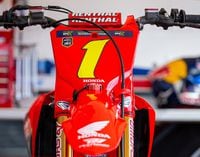
Nobody likes headshake, but unless you have the proper tension on your bike's headset, the ever-frightening speed wobble is almost inevitable. Especially useful on rough terrain, proper headset adjustment is a very important element to proper handling. We recently asked K.C. Agnew, head mechanic for Team Bloodshot/HMS Capital/Hahm Motorsports, to shed some light on the subject.Nobody likes headshake, but unless you have the proper tension on your bike's headset, the ever-frightening speed wobble is almost inevitable. Especially useful on rough terrain, proper headset adjustment is a very important element to proper handling. We recently asked K.C. Agnew, head mechanic for Team Bloodshot/HMS Capital/Hahm Motorsports, to shed some light on the subject.You don't want your front end to be too loose or too tight, so having the correct tension is really important. The first step is to loosen the crown nut and top triple clamp bolts-which will take tension off the fork-so they don't pinch or bind when you adjust the headset.Using a spanner wrench, adjust the spanner nut (located underneath the clamps on the stem). Tighten or loosen the nut depending on which way you have to go. Obviously, tightening the nut will increase the headset tension.Next, check the tension of your headset-it is important to be precise. Agnew recommends doing this with a fish scale (the kind you would use to weigh a small fish). With the bar straight, tie a string or a piece of wire onto a fork tube and pull forward with the fish scale. There should be exactly 4 pounds of pressure on the scale before the bar begins to turn. You can go tighter based on track conditions, but 4 pounds is the place to start.With the spanner nut at the correct tension, torque down the crown nut to the manufacturer's specifications. The headset will typically get a bit tighter as you crank down the crown nut, so sometimes you may need to go lighter on the spanner bolt to get the perfect tension. Over time, you will get used to what tension feels good.Lastly, tighten the top triple clamp bolts to the manufacturer's specifications. Use the fish scale to double-check your headset tension. Another way to check this, without the fish scale, is by turning the bar with the bike on the stand, because at 4 pounds of tension, the front end should slowly fall to the steering stop when the bar is set at a 45-degree angle.
Latest
/cloudfront-us-east-1.images.arcpublishing.com/octane/OFSXJJ5PZFEZ5D5ZPMCFVHJUMA.jpg)
/cloudfront-us-east-1.images.arcpublishing.com/octane/N2JLNLG44VEKBMEPORRDTMX5A4.jpg)
/cloudfront-us-east-1.images.arcpublishing.com/octane/EOERU244ONEWVKQ7C24OHMRVWY.jpg)
/cloudfront-us-east-1.images.arcpublishing.com/octane/JF4T3ULTGNHTVEKSTNKLJ2IGKY.jpg)
/cloudfront-us-east-1.images.arcpublishing.com/octane/FAOZEEEXFVA3ZK2PYMY3DHI2EQ.jpg)
/cloudfront-us-east-1.images.arcpublishing.com/octane/WCAUGYKA5FDZTB64FM36LJFMMM.jpg)
/cloudfront-us-east-1.images.arcpublishing.com/octane/EIDVOIN5IJDMRIVS2VNTOOBVSA.jpg)
/cloudfront-us-east-1.images.arcpublishing.com/octane/5BSWCTPONFB3DJFRPJ34STZMR4.jpg)
/cloudfront-us-east-1.images.arcpublishing.com/octane/KSERUHQUTNHLBCWKXS2R3TYZHI.jpg)
/cloudfront-us-east-1.images.arcpublishing.com/octane/GGOH2AQRSVHY5C5JLNEVYLB5SU.jpg)
/cloudfront-us-east-1.images.arcpublishing.com/octane/TJJEHV3ATZFFXHUYZABHXKE2DI.jpg)
/cloudfront-us-east-1.images.arcpublishing.com/octane/M7L5LNQ5JZENHNBTCHEIKZKD24.jpg)
/cloudfront-us-east-1.images.arcpublishing.com/octane/WIC4RXQ36BAXNIW6U4UJ3XDLKI.jpg)
/cloudfront-us-east-1.images.arcpublishing.com/octane/G64JLSXQBJFMVPTETPM4H353EU.jpg)
/cloudfront-us-east-1.images.arcpublishing.com/octane/ZBMLCCOSNJBIVAEC2OU6YSONKY.jpg)
/cloudfront-us-east-1.images.arcpublishing.com/octane/U7PDRXGEI5DCFJGSVGNLAHGIMA.jpg)
/cloudfront-us-east-1.images.arcpublishing.com/octane/S553MV5QAJFOHGOKYO7TJ6NGYA.jpg)
/cloudfront-us-east-1.images.arcpublishing.com/octane/62WLA7IMLVF2LIPTA4DGILHZIM.jpg)
/cloudfront-us-east-1.images.arcpublishing.com/octane/BW6RDLNDENAVFHMPINCIIY3XCI.jpg)
/cloudfront-us-east-1.images.arcpublishing.com/octane/FEROGJTVONBBZKEUH46OD6R2VY.jpg)
/cloudfront-us-east-1.images.arcpublishing.com/octane/IFBSQJ2HCFG5JKH4GM3NB5LC3M.jpg)
/cloudfront-us-east-1.images.arcpublishing.com/octane/GPNWD73XDJDG7LMXDVFDZ7CL2I.jpg)
/cloudfront-us-east-1.images.arcpublishing.com/octane/BDI3FSQXIFAYHNC62TCPI3DV7E.jpg)