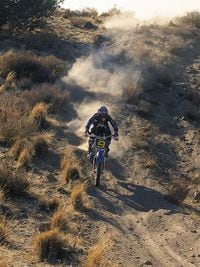
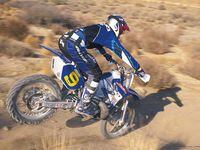
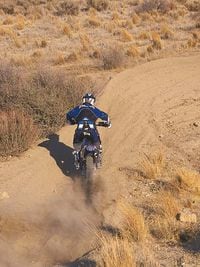
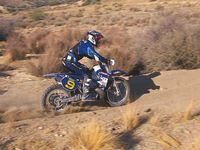
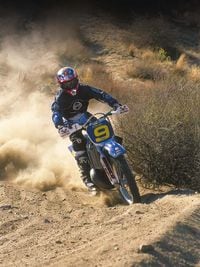
Entering a steep downhill with shadows and breaking bumps can be a hairball ride sometimes. As long as you keep a few things in mind and watch your body positioning, such headaches can be conquered safely at speed."Being in the attack position is also important; hold your elbows up, weight toward the rear of the bike and rear off the seat using your knees as shock absorbers by keeping them bent.""I control the bike better when I hit a breaking bump by keeping my heels down, the balls of my feet on the pegs and my weight back. As you can see, I am pushing back with my arms so the weight of my body will keep the rear of the bike from kicking me over the front end." Missing the bump altogether helps you to set up for the turn and allows you to maintain better corner speed. Turning on any off-camber is usually very difficult.""I try to stay in the lighted part of the trail, usually working the edges since everyone else tends to stay in the main line. Most importantly, looking ahead will help to keep you from having last-minute puckers," Davis explained."I look for two things: a breaking bump in the middle of the turn that I can pivot off of so I don't slide out or a berm on the outside such as the one I'm heading toward in this photo. I can use the big part of the berm to slow down and to pivot.""Hitting the kicker while having correct body positioning gives you more control of your bike. This helps me set up for the corner. The picture shows me braking hard to slow the bike enough to make the corner.""Missing the kicker leaves you in a better stance with the bike in a less violent position allowing you to set up for the corner sooner. This will let you to keep your corner speed."If you rail the corner when entering a sandy berm like this one, you may be surprised to find the top of the berm is soft and will push out causing you to knife the front end and fall over."
/cloudfront-us-east-1.images.arcpublishing.com/octane/KIWKUCDIAZEDXBC53B4CL23XX4.jpg)
/cloudfront-us-east-1.images.arcpublishing.com/octane/Z7SDMK75WBCKPOECPH2ZZC3MSE.jpg)
/cloudfront-us-east-1.images.arcpublishing.com/octane/2D4H2OGFH5ABPA4WIRHNSMBER4.jpg)
/cloudfront-us-east-1.images.arcpublishing.com/octane/MNV7VIZGBZACLJBL2WV7WVO7VU.jpg)
/cloudfront-us-east-1.images.arcpublishing.com/octane/H3ANF3MCT5BONNQAQISDYEJA4I.JPG)
/cloudfront-us-east-1.images.arcpublishing.com/octane/J7F3JQP2OVDLXDZ7VBJDMVGB4A.jpg)
/cloudfront-us-east-1.images.arcpublishing.com/octane/D3SZKDPELNAKPNAQIHTLZRF5QM.jpg)
/cloudfront-us-east-1.images.arcpublishing.com/octane/H5VKBUL2Z5BYDAOQOUQAHKOTEU.jpg)
/cloudfront-us-east-1.images.arcpublishing.com/octane/C2HS5ADXIND7LBDK37LGI5RN4E.jpg)
/cloudfront-us-east-1.images.arcpublishing.com/octane/SCDNATMCERHOHPEVO3JPCS6M2Y.jpg)
/cloudfront-us-east-1.images.arcpublishing.com/octane/TOQ7IBXN2BAV5MELGO5Y3W64UE.jpg)
/cloudfront-us-east-1.images.arcpublishing.com/octane/CSQ5SXR2QZEYLIH4GZVFYPKXNU.jpg)
/cloudfront-us-east-1.images.arcpublishing.com/octane/MLARWRCDL5HH3FYTXFXK26ARF4.jpg)
/cloudfront-us-east-1.images.arcpublishing.com/octane/QHHRQIMLX5DQREULLI7LJT2WOM.jpg)
/cloudfront-us-east-1.images.arcpublishing.com/octane/2MFKDMEXI5A2PAB2BCLJ4TE6CI.jpg)
/cloudfront-us-east-1.images.arcpublishing.com/octane/BCRBSND54FE3BDDWWMPP6LWCAY.jpg)
/cloudfront-us-east-1.images.arcpublishing.com/octane/53OLCW5X45HRTLKV5OVHFCJSJA.jpg)
/cloudfront-us-east-1.images.arcpublishing.com/octane/PUS7VYTISVCVXGLWRGNHS7ZR4M.jpg)
/cloudfront-us-east-1.images.arcpublishing.com/octane/UO25RAAEQJDIVLNGY2L7S4IRDQ.jpg)
/cloudfront-us-east-1.images.arcpublishing.com/octane/3GQBZGCTXRE35IIIOI22RBQSOU.jpg)
/cloudfront-us-east-1.images.arcpublishing.com/octane/OIT4RWYSOJGOFJE2LLVSYGMRXY.jpg)
/cloudfront-us-east-1.images.arcpublishing.com/octane/Z4GKM7BKVBAKDBN37S5R4QR4LA.jpg)
/cloudfront-us-east-1.images.arcpublishing.com/octane/ZM6HFGPAQVDAHFMPXXKVCUMU2U.jpg)
/cloudfront-us-east-1.images.arcpublishing.com/octane/7ZOMH2FJNFEADEHWZFX6FHY3K4.jpg)