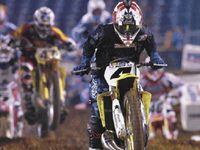
The greatest idea in motocross is not the water-cooled motor, the backward-falling start gate, the monoshock or the full-face helmet. Making the four-stroke engine race competitive has certainly shaken things up. And the track-crawling watering truck and other grooming machinery are doing to MX courses what the Zamboni did for ice hockey rinks. There's a long list of innovations that have made the sport safer, more competitive and more exciting for all involved. However, all of these pale in comparison with the single greatest idea in the sport to date: strapping a camera to Ricky Carmichael's helmet and broadcasting the images to living rooms everywhere each week as part of the supercross television coverage.Sure, the helmet cam has been around for a while, but this season, for the first time ever, the home audience now knows what it feels like to travel at the pace of one of the greatest motocross racers of all time. Thanks to this idea, we can all vicariously peer through Carmichael's Oakleys and catch, salute and pass Jeremy McGrath over a triple. Now we know what it looks like to reel in and dust the defending supercross champion not once but twice during a single main event. By definition, lappers are riding slower than the top racers in the field. However, the helmet cam renders them as stationary as Tuff Blocks as we watch RC run up on these stragglers and then blow past in an instant.The first-person view through the Daytona whoops actually made my sofa cushions buck and my sphincter pucker. This sequence visually defined RC's tenacity by giving us the champ's perspective hanging on until the loss of friction pried his grip from the bar. You know it's good footage when David Bailey and Rick Johnson confess this perspective of Carmichael's speed scares them, and subsequently they sit in silence for an entire lap. For these 60 seconds, give or take, the only commentary is the smooth whine of an expertly tuned racing motor with intermittent blips of the throttle as RC airs it out over a triple and then gives it a hard push to the corner followed by the seemingly way-too-early low-end wail used to steer the bike out of the apex with the rear wheel. This truly is "must-see TV."Following the axiom "more is better," I'd like to see not only more helmet cams for the other top pros but also rear-mounted cameras la Superbike and other motorsports television broadcasts. The motocross viewing experience would only be better if the fans at home could see the front and rear fenders of RC and Bubba rubbing together in the berms. Just how tight does it get during the chase for the holeshot? That would be an easy question for a rear-mounted fender camera to answer.Just one of the difficulties in covering a sporting event is translating the intensity of the competition, whether it be the speed, the proximity of the athletes or the extreme conditions of play. The XFL football league was a critical and financial flop. However, its creators dreamed up innovative camera angles to cover the action, some of which have been adopted by the NFL. And the broadcasts have benefited. I don't think track and field, swimming or horse racing would be nearly as exciting to watch on television if it weren't for the rail-mounted cameras traveling alongside the competitors providing a palpable rush. With that in mind, just imagine a rail-mounted camera traveling the length of the start straight up and around the Talladega turn at Glen Helen, navigating the long and gnarled whoops of Millville or, better yet, sailing along the trajectory of your favorite rider over LaRocco's Leap at Red Bud.Along with any innovation comes monetary and safety implications. So I'm not holding my breath for the next greatest idea to come to fruition. Until then, I'm pulling up the sofa, turning up the volume and enjoying the best sport on the planet with the best cameraman on the planet. And instead of cheering, "Hey RC, nice pass," it's now, "Hey RC, nice shot!" -Rodney Webb
/cloudfront-us-east-1.images.arcpublishing.com/octane/X4HH3H6LWFEAXFAOS4D7WPCBGU.jpg)
/cloudfront-us-east-1.images.arcpublishing.com/octane/KIWKUCDIAZEDXBC53B4CL23XX4.jpg)
/cloudfront-us-east-1.images.arcpublishing.com/octane/Z7SDMK75WBCKPOECPH2ZZC3MSE.jpg)
/cloudfront-us-east-1.images.arcpublishing.com/octane/2D4H2OGFH5ABPA4WIRHNSMBER4.jpg)
/cloudfront-us-east-1.images.arcpublishing.com/octane/MNV7VIZGBZACLJBL2WV7WVO7VU.jpg)
/cloudfront-us-east-1.images.arcpublishing.com/octane/H3ANF3MCT5BONNQAQISDYEJA4I.JPG)
/cloudfront-us-east-1.images.arcpublishing.com/octane/J7F3JQP2OVDLXDZ7VBJDMVGB4A.jpg)
/cloudfront-us-east-1.images.arcpublishing.com/octane/D3SZKDPELNAKPNAQIHTLZRF5QM.jpg)
/cloudfront-us-east-1.images.arcpublishing.com/octane/H5VKBUL2Z5BYDAOQOUQAHKOTEU.jpg)
/cloudfront-us-east-1.images.arcpublishing.com/octane/C2HS5ADXIND7LBDK37LGI5RN4E.jpg)
/cloudfront-us-east-1.images.arcpublishing.com/octane/SCDNATMCERHOHPEVO3JPCS6M2Y.jpg)
/cloudfront-us-east-1.images.arcpublishing.com/octane/TOQ7IBXN2BAV5MELGO5Y3W64UE.jpg)
/cloudfront-us-east-1.images.arcpublishing.com/octane/CSQ5SXR2QZEYLIH4GZVFYPKXNU.jpg)
/cloudfront-us-east-1.images.arcpublishing.com/octane/MLARWRCDL5HH3FYTXFXK26ARF4.jpg)
/cloudfront-us-east-1.images.arcpublishing.com/octane/QHHRQIMLX5DQREULLI7LJT2WOM.jpg)
/cloudfront-us-east-1.images.arcpublishing.com/octane/2MFKDMEXI5A2PAB2BCLJ4TE6CI.jpg)
/cloudfront-us-east-1.images.arcpublishing.com/octane/BCRBSND54FE3BDDWWMPP6LWCAY.jpg)
/cloudfront-us-east-1.images.arcpublishing.com/octane/53OLCW5X45HRTLKV5OVHFCJSJA.jpg)
/cloudfront-us-east-1.images.arcpublishing.com/octane/PUS7VYTISVCVXGLWRGNHS7ZR4M.jpg)
/cloudfront-us-east-1.images.arcpublishing.com/octane/UO25RAAEQJDIVLNGY2L7S4IRDQ.jpg)
/cloudfront-us-east-1.images.arcpublishing.com/octane/3GQBZGCTXRE35IIIOI22RBQSOU.jpg)
/cloudfront-us-east-1.images.arcpublishing.com/octane/OIT4RWYSOJGOFJE2LLVSYGMRXY.jpg)
/cloudfront-us-east-1.images.arcpublishing.com/octane/Z4GKM7BKVBAKDBN37S5R4QR4LA.jpg)
/cloudfront-us-east-1.images.arcpublishing.com/octane/ZM6HFGPAQVDAHFMPXXKVCUMU2U.jpg)