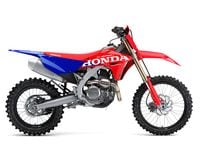
The WR is a tamed-down race bike that can be unleashed at the owner’s discretion. We liked it close to stock.
The KTM is the sleeper of this bunch. It is very smooth on the bottom while still retaining more of that four-stroke thump than any of the other bikes. It is pleasantly smooth on the bottom but comes alive into the midrange with a surge that most riders liked; the boost was there just when you wanted it to light up the tire, lift the front end or catapult the bike forward. The EXC works best in the midrange, which is the main reason the gearing is critical. The top-end pull is there yet lackluster in comparison to the other bikes’. In everyday riding, you’ll hardly be bothered by the top-end as you are only an upshift away from another meaty pull of midrange. Due to the lazy bottom, the KTM suffers in roll-ons, and it takes a bit more skill to run with its fellows in drag races-shift timing is everything. Use of the clutch negates any disadvantage the orange bike suffers under. But on the trail, this power was complimented and appreciated by everyone; its uniqueness here set it apart, always in a good way.The new KLX-R feels like the fastest bike of the bunch. It has a responsive and snappy throttle that initially seems aggressive. But as soon as you realize the bike gets phenomenal traction and can handle the seemingly snappy power, you’ll find the package really starts to work as you get more and more aggressive twisting it. The motor is electric like the Yamaha’s and deliberate like the Honda’s-the absolute opposite of the KTM’s. It builds smoothly all the way to the top-end, doing it quickly enough to have every one of our testers wonder why anyone would want to replace the super-quiet stock exhaust. Stacked up against the others, it is the slowest, too. It gets pulled in roll-ons and is just a bit slower in all-out drag races. In the real world, especially when the rpm are higher, it has no problem going fast and is exciting to ride all the time. Only in the much slower-going do riders realize that they have to use the clutch a tad more and can’t chug the bike to a total crawl without a downshift.The bikes’ handling and suspension prowess in the higher speeds also showed we have four distinct characters here. The Honda is stable, light feeling, agile and suspended to tackle anything we threw at it. It was that good but, in this bunch, not the best at anything, except maybe bottoming resistance. It has a stiffer initial feeling in the chop than the other bikes and lets you feel the ground. All of its turning manners are middle of the road and very precise: steering on the front or sliding with the rear. Although thin, it feels a little wider and slightly heavier than the other bikes. Yes, it’s heaviest of the light-feeling bikes.KTM comes in at the complete opposite side of the spectrum. It is tied with the KLX-R for being the lightest feeling and the lightest steering. The KTM goes over the top with the plushness of its suspension. If you don’t like to feel any of the bumps, the WP suspenders do the job. And this bike fights off the wallowy feeling that comes with super plushness-the best we’ve ever felt. If it suffers anyplace, it’s that it doesn’t have the stiffness to give you a kick or lift off of little bumps. Whereas you can jump them on the other bikes, the KTM absorbs them. This bike is not for moto-inspired riding, and stiffening the clickers does not bring back this feeling (if you like it in the first place).The Yamaha has seen the biggest improvement in weight feel since the last rendition of this bike and, in doing so, has passed the CRF-X in weight feeling, especially in the side-to-side movement, where it was a bit on the top-heavy side in the past. It has gotten lighter in the steering feel and even better in the suspension-plushness department, an area that usually suffers when a bike gets a lighter feel. The WR fills the gap between the stiffer CRF-X and the plush KTM to a very happy place that everyone liked. As far as weaknesses go, some riders felt the front end bottomed too easily, something we’ve readily cured on our WR250F by raising the oil level in the fork.Kawasaki has found the magic recipe in weight feel, because the KLX-R feels and acts light on its wheels. The steering feel is feathery, and it is hard to believe this bike shares so many parts with its motocross brother because even that bike doesn’t feel like this, and it isn’t smuggling a battery, electric starter and a host of other off-road goodies into the game. Along with this is a well-balanced suspension that has a stiff nature, letting a rider push the bike hard and have a good feel for the ground-not ricocheting off of rocks or bumps and still being plusher than all but the KTM. If there were any complaints, it was about the front end not biting in the turns, though this can be clicked away with slightly less compression in the fork. And for a bike that utilizes so much recommended sag (112mm), one would think it is a mask for instability. But the bike ran straight all the time, even with less sag, though the turning didn’t respond to this like we’d expected. Is there a winner here? Either the mellow KTM or the peppy KLX-R, you decide.
Accoutrements for faster off-road riding would include larger gas tanks for range and skid plates for bashing into rocks. None of these bikes possess standout features for this type of riding. The KTM was the first to run out of gas, the Honda the last. You can easily stretch 60 miles out of a tank or kill any of them in 45 by being heavy with the wrist. Brakes on all the bikes are solid; most riders notice that the Honda has the best feel and the strong KTM binders have the least feel.Taking It to the Trees Slowing it down a bit and turning a lot more, we rode the bikes in the forests and mountains to get a better grasp on the players. Some things changed, and some things didn’t.The Kawasaki showed the biggest difference. It was funny how the slowest bike was praised the most in the fastest riding, yet in the tight trees, riders were polarized. The light feel was still tops and handling drew very few complaints. But the smooth low-end power and comparative lack of torque had some asking for a little more. They were bothered by the extra downshift the KLX-R preferred or didn’t like revving the bike more. Riders fresh off of a 250F would not even notice; most would be hard pressed to pick this out if not coming off another bike with more low-end tug. But in really tight trails, this one trait stuck out. The KLX-R clutch stood up to the abuse, as did the engine, rarely using the coolant catch tank. And this lower-speed quirk was most noticeable at a fast trail speed. Go for a true sightseeing ride or race through a section and you won’t understand what we are talking about.The Honda fights its powerful low-end and extra girth in the tighter sections. Feeling a bit heavier is one thing; adding in the snap and aggressive bottom power is another. Add those two things up and multiply them by a rider who has less throttle control and you can be in for a more tiring ride. Be smooth with the wrist and the CRF-X is as gentle as can be, especially if you are on the heavier side of the scale, because for you the suspension works better, too. We would say the Honda can be the best for the novice rider because of the low-end chug, but at the same time, caution the same guy about the low-end burst. Everything else in the trees is good, especially the steering.The KTM stays light, stable and ultracompliant in the tighter stuff, with suspension settings that seemed made for trail riding in the woods. Its smooth power finds the traction in the slippery stuff and has pull when you need it. Some thought it was soft off the bottom, mostly lacking the snap to get going, not the torque to keep from bogging. Here, the light feel, particularly in turning the bar, aids the bike in getting through the woods as easily as can be. The bike received high marks for being thin, especially at the footpegs, keeping toes out of peril.The Yamaha is such a bland ride that nothing stands out, at least in terms of bad traits. It seems to do everything well-nothing astoundingly so-and makes everyone happy the whole time. Its slightly heavier feel doesn’t bother anyone. Its suspension is just plush enough to absorb the small stuff and stiff enough to allow racelike speeds; the clickers give a good range of adjustability, especially the high-speed adjustment on the shock. The motor, being electric feeling, pleased everyone. It has a wrist-to-rear-wheel connectivity that rivals anything out there-this even in its leaner-than-full-power jetting setting. Here, it resists breaking traction (the GYTR jetting is more than happy to spin the wheel, as well as get finicky at elevations above 7000 feet) and gets great fuel mileage for a bike with such a thin gas tank.Garage Time You’ll likely work on your ride, and we did all the regular stuff on these bikes during this test. Changing air filters revealed that the KTM rules with the easiest access and safest seating, right in front of you. Yamaha is second; it has a bit more room to work with than the others. The tight confines of the Kawasaki and even tighter box of the Honda make them slightly more difficult. Oil changes are a single-drain-plug no-brainer on the KTM, and you have the double-oil-filter setup to keep the lube looking good and working well for a long time. We’ve put more than 30,000 miles on an RFS motor, and that isn’t bad for a bike that was introduced in 2000 as high-performance and possibly short-fused. The rest of the bikes have a routine and more than one drain bolt, but even a novice could figure them out. Worries about engine life are moot at best. Keep the air filters clean and the oil fresh, and you’ll run them forever if you’re wise enough to check the valves once in a while.Speaking of which, all the valves are pretty easy to get into to check, with the KTM being the most difficult due to space. But if adjusting comes into play, the KTM is the only one with screw-type tappets and takes only 10 minutes to set. The other bikes require shimming, a two-hour job. All of the bikes have their fasteners dialed without any standout funkiness that pinged our junk-o-meter. We liked the coolant catch tanks on the Japanese bikes, and the steel rear sprocket on the WR lasts forever. There are enough odometer functions in this group to make your head spin, but the Kawasaki is the only one on which you can read the speed while riding (except in the dark). The KTM’s stock light is the only one worth riding with at night; the Yamaha’s light comes close. The other two will get you back if a ride runs late, not much more.
Do We Have a Winner? Simply put, yes. Each bike has its own strong points, and the weaknesses are so small in comparison that you can’t lose. The Yamaha suffers with a restricted stock setting, but uncorked it comes into its own. Pulling off a balancing act like this in the off-road world is just what the WR is good at, and we couldn’t fault it once we got it dialed. The Honda is the eldest in design and is seeking some tweaks to catapult it to the front of the class. As the CRF-X is ridable right off the showroom floor, none of our testers would mind owning one; a few would still pick it as their outright choice. Not a bad rating considering we still like the most dated, most easily picked-on bike this much. Kawasaki came out of the gate with a stellar machine that ups the performance bar above all, even the KTM. It is everything most riders could ever need in an off-road bike and, in the collective opinion of our staff and test riders, missing only one thing, but that one thing keeps the KLX-R from winning. It’s the thing the KTM has: a license plate.The KTM EXC wins in our book because in a lot of places you need that little gem hanging off your rear fender to make riding possible. It makes more riding, yes, dirt-only riding, a reality. And in some states, it had better come from the dealer wearing that plate, because you can’t convert a dirt bike to a streetbike. We’d have ranked the KTM 450 XC-W lower, but in this comparison and for the future of off-road bikes, the KTM 450 EXC wins.Making the Yamaha Run It is pretty easy to make the WR go from snore to score. Just buy the GYTR kit (GYT-5TJ93-69-01, $49.95) that includes the shorter throttle stop, a block-off kit for the Air Induction System (AIS) and a set of jets that bump the power by richening the jetting, then follow the included instructions. This is how we tested the bike in Costa Rica for its debut and in our first test. But in light of current standards and enforcements here in California, we also came up with the setting that we tested the bike in for this comparison. We used the shorter throttle stop, took out only the smallest stuffer from the muffler and removed the restrictor from the top of the airbox. We also disconnected the gray wire at the six-pin connector underneath the left sidepanel. We left the stock jetting in the bike and did not mess with the AIS, as it has no performance effect on the engine aside from causing the lean popping noises inside the exhaust. With this setting, we felt the bike was more ridable and smoother in the smaller throttle positions than the GYTR-jetted bike, and it got better fuel economy. Plus, it ran better at elevations above 7000 feet.Tuning the KTM The KTM is a dirt bike in a streetbike tutu. It has to have really tall gearing, a squeaky clean tailpipe and evaporative emissions (all dirt bikes will need to have this soon) to make the grade for the license plate. But we wanted that plate and to have our dirt bike back, which was easily had by dropping the skirt and pulling on a pair of pants. First, we tossed the stock 15/47 gearing and went to a 14/48 using the same chain. That was not enough, so we bumped it to a 14/50, still running the stock chain but flopping the axle blocks 180 degrees. Perfect for some, yet still gappy for others, this combo nevertheless totally eliminated the previously necessary clutch abuse on the trails and the resultant heat increase to an already hot-running lean engine. Making the throttle response come to life was almost as simple. Bumping the pilot jet from a 42 to a 48 and moving the clip position from the third position to the fifth got the hesitation minimized and the engine’s lean-hot temperature better under wraps. Another thing that improved response was a Ready Racing Rapid Response throttle linkage (www.readyracing.com) that helped the response even more. Further gains were had by way of a Boyesen QuickShot2 (www.boyesen.com). One other trick: We relocated the horn away from the front of the radiator for better cooling. We put ours behind the headlight shell. We didn’t touch the evaporative emissions lines or even remove the charcoal container tucked up in the airbox, though we could have easily done that. But one of the most important modifications you can do is to reroute the crankcase breather hose. Stock, it plugs into the back of the carb, and excess oil, especially on long downhills or in tip-overs, will flood into the carb and make the bike run poorly, or not at all. We took the hose, reversed it and routed it back to where the carb vent lines hang, and plugged the carb with an older KTM two-stroke coolant drain plug. On this bike, you should leave out the vent-line drain box’s drain bolt, so the excess fuel can escape. And the pipe on the EXC is extra restricted to damp the sound beyond what the older-version KTM spark arrestors are capable of doing. By going to one of those older mufflers (or opening up the EXC’s end-cap and removing the smallest snorkel), you can still pass the sound requirements easily. The bike does get louder when it is running at high rpm. At the same time, it definitely picks up some low-end grunt to get into the healthy midrange sooner.Honda CRF450X MSRP: $7399 Weight (ready to ride, no fuel): 276 lb
Seat height: 35.6 in.
Seat-to-footpeg distance: 19.9 in.
Ground clearance: 11.6 in.Yamaha WR450F MSRP: $7199 Weight (ready to ride, no fuel): 276 lb
Seat height: 35.1 in.
Seat-to-footpeg distance: 19.5 in.
Ground clearance: 10.6 in.KTM 450 EXC MSRP: $7998 Weight (ready to ride, no fuel): 275 lb
Seat height: 35.1 in.
Seat-to-footpeg distance: 19.0 in.
Ground clearance: 11.5 in.Kawasaki KLX450R MSRP: $7299 Weight (ready to ride, no fuel): 278 lb
Seat height: 35.4 in.
Seat-to-footpeg distance: 19.5 in.
Ground clearance: 10.8 in.