Size Matters! – Find The Dirt Bike That Really Fits You – Dirt Rider Magazine

By:

Tuesday, February 24, 2009

A perfect bike is one that fits you, works where you ride and at your speed. It should make you grin when everything is working great, and have readily available parts and service from a dealer you trust when it isn’t. Under those guidelines, one rider might be happiest on a KTM 525 and another would be comfortable on a Honda CRF100F. Sorry, but we can’t tell you which bike to buy. Only you know how and where you ride, your skill level and your physical traits.Yet most of the e-mails and letters we receive ask about choices. They start with (choose one): “I’ve been out of riding for a while…”; “I’ve been riding a two-stroke and am thinking about a four-stroke…”; “I’m a big guy…”; “I’m an older guy who began riding with my family…”; “I’m a short guy….” You get the idea. The unifying aspect of these letters is the type of riding anticipated: “I ride wooded trails and I want to play at the track once in a while.” Finally, they branch out again, asking about choosing a 250cc two-stroke or which size of four-stroke. “What do I do?”

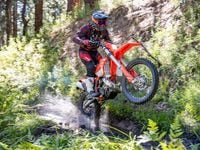
Pete Peterson<br />Rory Sullivan<br />Derek Steahly/></a>
<p class="wp-caption-text">Pete Peterson<br />Rory Sullivan<br />Derek Steahly</p>
</div>
<p><strong>Moto</strong>
<p>Fair enough. The real question is, “Which bike is the best size?” We had a plan to shed some light on that question. We chose Yamahas for our test subjects. Why? Because the YZ250 is the best of the available MX two-strokes for the track and rated well as an off-road mount, as we discovered in our ’06 shootout (Dec. ’05). In addition, the YZ250F has very usable power, and the YZ450 has a five-speed, making it off-road versatile.For the MX portion of our evaluation, we visited a variety of tracks to come up with a setup that allowed riders to switch from bike to bike without a lot of time required to acclimate. Then we took lap times from two riders who are very representative of the letters we receive. Billy Oulette is a super-fit senior CRF250R pilot who was once a top-15 national motocross guy with a Yamaha pro support ride. Cycling keeps Oulette’s 5-foot 10-inch frame weighing in at 155 pounds. Nate Evans is a KX450F-owning 6-foot-plus vet who weighs 220 pounds. He races WORCS and GPs but practices regularly on the moto track. We completed the lap times at I-5MX, a faster track with firm soil and some elevation changes.<strong>Results</strong>
<p>It isn’t too surprising that Oulette, being lighter, had lap times that were pretty consistent regardless of bike size or type. He turned laps between 2:16 and 2:19 on the 450F, consistent 2:20s on the YZ250 and between 2:18 and 2:19 on the YZ250F. Nate’s heavier build took a toll on the YZ250F, and his times ranged between 2:21 and 2:23. He was most consistent on the 450F, but effectively his speed was identical on the YZ250. The times were between 2:18 and 2:19 on the 450 and 2:18 and 2:20 on the two-stroke.<strong>Track Setup</strong>
<p><strong>YZ25OF</strong>
<li>Stiffer rear spring to allow heavier riders to get along with it.
<li>Acerbis white plastic kit to make the bike distinctive from the 450.
<li>Applied triple clamp to move the bar mount forward and raise the handlebar
<li>Fastway footpegs to make the riding position more roomy
<li>Sunline 2005 YZ450 shift lever to make shifting easier with the wider footpegs.
<li>Dunlop D742 front tire/D952 rear tire.
<li>Stock muffler
<p><strong>YZ25O</strong>
<li>Race Tech suspension set for a cross between off-road and moto
<li>ProTaper top triple clamp to allow adjusting the bar position.
<li>Dunlop D742/D952 tires.
<li>FMF pipe
<p><strong>YZ45OF</strong>
<li>Stiffer rear shock spring.
<li>Applied top and bottom triple clamps to change offset and add room to the riding position.
<li>Dunlop D742/D952 tires
<li>Stock exhaust.
<div><a href=

Off-Road

For the off-road section of the test, we arrived early for the Boise Ridge Rider’s Idaho City two-day qualifier. That gave us several days to spend time riding all three bikes on the trails. The club had established a jetting trail that consisted of single-track with a good selection of climbs and descents. The trail was mostly medium speed, but there were open parts and some tight sections. We ran the trail both directions for time, for a total trail length of approximately 5 miles. There were dry areas and parts that still held moisture. We used three ISDE hopefuls for times. Dan Thoren is a big guy who usually races a KTM 525 SX. He’s 6 foot and weighs over 210 pounds, but he’s still fast. Associate Editor Derek Steahly is an inch taller than Thoren but weighs almost the same. His usual weapon of choice is a two-stroke 250. Rory Sullivan is 5 feet 10 inches and 170 pounds. He is a national pro moto guy who has switched to off-road. He owns a KTM 250 SX and a 450 EXC. Karel Kramer and our new flyweight web producer, Pete Peterson, rode the three bikes on the trails for opinions as well.Results

We figured that the almost equal mix of climbs and descents would still be fair on the 250F, but with our group of faster riders, the results were definitely a power thing. Thoren and Sullivan were fastest on the 450, three seconds slower on the 250 and another three seconds slower on the 250F over the five miles. Steahly, who self-admittedly isn’t a 450 fan off-road, was fastest on the 250, three seconds slower on the 250F and another second slower on the 450.Off-Road Setup

YZ25OF

  • FMF Q quiet spark arrestor/muffler.
  • Steahly heavy flywheel weight
  • GYT-R plastic chain guide.
  • GYT-R aluminum skid plate.
  • GYT-R magnetic drain plug.
  • GYT-R billet fuel screw.
  • Acerbis flag-type hand guards.

    YZ25O

  • FMF Q quiet spark arrestor/muffler.
  • FMF Gnarly pipe.
  • Steahly 8-oz flywheel weight.
  • Scotts Performance steering damper.
  • Cycra wraparound hand guards drilled for hot weather.

    YZ45OF

  • FMF Q quiet spark arrestor/muffler.
  • GYT-R heavy flywheel
  • GYT-R chain guide and skid plate.
  • Cycra flag-style hand guardsOpinions

    I don’t care about being competitive in motocross any longer, but I do like to ride on a prepped and watered practice track. Moto is all about fun for me, so I want to be on a 250F whenever possible. They are just more fun, and I feel safer on them. For technical, rocky, root-strewn trail riding or racing, I’ll still opt for a 250F, but I was surprised at the lap-time penalty bigger guys paid. My actual off-road riding is in areas of the high desert that have deep sand and large hills, so give me a 450 for there. If I lived where mud, ruts, trees and roots were more common, I’d probably go for a 250 two-stroke.
    Karel Kramer/6’1″/210 lb/Senior B, Senior IntermediateIn tight woods, the 250s are the way to go, because you can throw them around easier. It even works better than a 450 on tricky combo jumps and tight corner sections on the moto track. The 250F is pure fun, and I was shocked that I was so close to the 450 lap times in spite of my weight. I can see why they destroy 125cc two-strokes. But for my riding on the track and GPs, I’d take a 450. I still care about my results, and here in the West, the bigger engine is easier to ride, mistakes cost you less and I’d have better results on the 450.
    Nate Evans/6’1″/220 lb/Vet IntermediateLast place on the podium for me is the 450. The big bike is a crutch to a lot of unskilled riders. Just go to any MX track in the country, and there are squids with droopy elbows looking at their front fender while jumping everything on the track. The power makes it too easy. The combination of weight, rotating mass and power makes it hard to pick your own lines. I like to ride the edges of the trail, cross the main line and stay out of the rough; and that’s harder on the 450. I feel like I only use about 13 percent of the 450′s potential. I like to push a bike so I feel fast, but I feel slow on a 450. My lap times proved it. If I tried to ride a 450 hard, especially in the woods, I would crash big and go boom. I am big and I’m a decent rider, yet I’m still 87 percent away from tapping the 450′s full potential. Basically, I get bored every time I get on a 450!Runner-up goes to the mighty 250F. The little four-stroke feels super-light and is easy to muscle around. I like that! I feel like a hero because I can rev the piss out of it without risking my neck. I like to be able to use everything the bike has. The slower bike makes me work on picking faster lines and makes me a better rider. The fun factor on the 250F is sky high, especially when I blow by a goon on a 450.I was really surprised to see that my short laps were as fast on the 250F as on the two-stroke. When we did the short lap times I thought the bike was at a disadvantage because it lacks horsepower. Nope, I was just as fast on it as I was on the two-stroke. On a longer loop, though, I was much faster on the two-stroke. I ride the two-stroke the fastest and I feel fastest on it. It is light and flickable; I pick my own lines. Short-shift a 250, and it’s mellow and works well in tight and gnarly stuff. Then in the fast stuff it rips. I can use most of the power, and these machines are easy to work on and maintain. Plus, I have the most fun on them. It’s all about the fun, right? Top spot goes to the 250 two-stroke.
    Derek Steahly/6’1″/215 lb/ISDE medallistMy initial feeling was that I went fastest on the YZ250. The motor is practical, usable and forgiving in addition to producing great power. I could make mistakes with no fear of stalling or needing to abuse the clutch. If I was fresh, I could ride the bike on the pipe, and when I got tired, I could lug it around and short-shift it-all at the same speed. That’s nice when the bike serves multiple uses. The 450 was definitely the most entertaining and exhilarating, but that isn’t always practical. I really noticed a difference in corner speed when I was in technical sections. The 450 wants to decelerate hard and accelerate even harder, but nothing in between. I’d fumble through corners and launch down the straights-huge fun, just not very efficient. The 250F was most surprising. I thoroughly enjoy riding the small four-stroke. I’ve never considered buying one, and to be quite honest, I still wouldn’t. I was surprised to see the small difference in times between my 250F and the 250. A longer test would have shown a greater difference. It takes work and concentration to ride the 250F at race speed or even a fast trail pace, and it’s harder to recover from mistakes. It produces impressive torque but not enough to keep the bike moving quickly in difficult terrain (especially with a heavy rider).Which would I buy? It depends. If I were just looking for the most fun in the most situations (play riding), I would buy the 450 in a heartbeat. It’s an absolute blast to ride, and I found myself smiling the most often on it. If I were shopping for a race bike, I would buy the 250. It might not be as fun to ride as a thumper, but it is still the best tool for racing in the woods. I think the 250F would make an outstanding second bike. It just isn’t universal enough for me.
    Dan Thoren/6′/218 lb/A riderThe 450F doesn’t cooperate in turns or in finesse situations on the track but it is surprisingly willing off-road. Its power-on-tap is great for those obstacles that sneak up on you. The 250 two-stroke is dirt-dependent. On ground with good traction, the bike is responsive and fast, but the power, even on the smooth YZ, can be too abrupt and rev too quickly for slick conditions. Still, the two-stroke is a great bike and feels better the harder you ride it. I feel more comfortable in every track situation on a 250F; leaned over or in the air, the bike listens to me. Even on slick hardpack, the 250F feels great. But out on the trails, the 250F is lacking in burst-of-power situations where the 450 has chug and the two-stroke has snap.
    Pete Peterson/5’10/155 lb/Vet B MxerThe 250F is light and nimble in the woods, but it is underpowered when you need instant wheelie power for an obstacle or when the trail or track makes an abrupt turn uphill. A 250 is almost a bit too snappy and a little harder to control, so it takes more energy to ride hard. I like the power of the 450, and if you are in shape, you can get ‘er done on the 450. So I’d say get in shape and get a 450!
    Rory Sullivan/5’10″/170 lb/Pro MX, A off-roadI was a pro motocrosser in the early ’80s, and I just got back into riding after being away for over 10 years. I bought a 250F, and I think it was a great choice for getting back into riding. I even returned to the track, and the little thumper made it easy. Now that I have a couple of years back on a bike, I’m thinking it might be nice to have a 450. If I were riding just track, I’d stay with a 250F, but since I ride in the desert during the winter, I think I’ll be looking at a 450 when it comes time for a new bike.
    Billy Oulette/5’10″/155 lb/Senior Expert MX

    In terms of hard numbers, the 250cc two-stroke is far from dead. Our test, despite using forest trails considered tight for the West Coast, were still more open and flowing than Eastern trails. That allowed the 450 to make a good showing, but the opinions leaned toward smaller bikes, especially for lighter or nonpro riders. And usually lap times are only important to racers. Most of our letters were more concerned about fun factor than they were about the trophy quotient. So this is what we learned about how much the size of the bike matters: It should matter to you, since there are distinct and concrete reasons to choose one size and type of bike over others. There is not one size that is simply best. Here are the findings in a nutshell.So as we insisted in the beginning, we can’t and won’t tell you what to buy. We’ve tried to explain the pros and cons of each bike, and in the opinion section, we’re happy to tell you which bike we’d buy!450F
    In many ways a 450 makes motocross easy. You can clear almost any jump you point it at if you have the commitment to the throttle. Starts are easier, and it takes a much bigger hero to wring the neck of a 450 than it does to wear out a 250F. A 450 can make you lazy in the turns and lackadaisical with the clutch and shifting. As fun as the power is on a faster track, a 450 motocrosser can easily be too much for technical trail situations. A 450 is a little more tiring to kickstart, even more so after stalling, which, believe it or not, happens more than on the other bikes. Remember the lazy part? If you are a big guy who is serious about racing, you have almost no choice but ride a 450 for MX. On the other hand, a stock 450cc MX bike is not much fun in the woods. If you live on the Western side of the continent, the 450 deserves more consideration off-road than it does in the densely wooded East.250 Two-Stroke
    A 250cc premixer has boost that is much closer to a 450 in quantity, at or just above the weight of a 250cc four-stroke. For many riders, the two-stroke proved harder to ride fast consistently on the MX track, and that is doubly true in suspect traction. Off-road we found that a 250 two-stroke is still an awesome weapon in tight and tough riding and racing-just look at its popularity in the GNCC series. As good as they are for racing, two-strokes do not like poking around at small throttle opening and no load, so if you plan on doing any slow riding with family members, a four-stroke will be more convenient.25OF
    For racers, if you are at least 30 (because you’ll race in age classes where all sizes of machinery run together), then riding a 250cc four-stroke will be tough duty. You will be hard-pressed to get a good start and will have a tough time passing anyone under acceleration. You’ll need to have game on the brakes, in turns or over technical sections to prevail. Judging from the comments we heard, it might be more fun to lose on a 250F than to win on another size machine. If you are riding and racing for fun, a 250F is tough to beat. They make you feel fast and aggressive, and a pretty normal rider will run one closer to its limits than a more powerful machine. Off-road, a 250F is a hoot, and the grins get bigger the farther you stray from deep sand and mud or big horsepower hills. For firm, mostly flat but tight wooded trails, a 250F is a weapon. And for those riders looking only at a four-stroke, it will be a bunch more fun and controllable than a 450 MXer and just as light as a 250cc two-stroke. For heavy guys, you’d be riding one for fun, because you’ll be less competitive than a lighter guy. The lap times proved that.More Lap Times

    To give you a better idea of which bike is best for racing, we examined WORCS and GNCC event results to see which size bike had the fastest lap times. Times were taken from the 2006 Loretta Lynn’s and Wisp GNCCs as well as the Washougal and Adelanto WORCS races in the B and C divisions. We averaged the lap times of the 250F, 250 (two-stroke) and Open classes in the WORCS events. For the GNCCs, we averaged the times of the equivalent classes. Care was taken to throw out any outlying times so as not to affect the outcome of the averages. These averages suggest that for the shorter laps and more open terrain at the WORCS races the two-stroke 250s still have a bit of an edge, even more so at the GNCCs. The big-bore bikes are a little slower on both coasts. These numbers are what we would predict judging from our own test results and should give riders in all parts of the country some help choosing a machine.

  • Follow Us:
    Subscribe
    Dirt Rider Magazine