
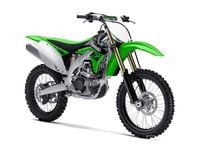
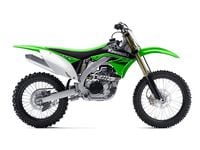
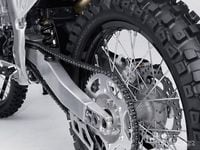
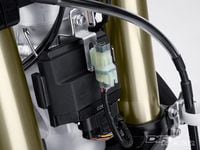
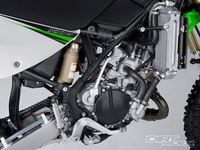
The biggest news from the Kawasaki camp is the absence of fuel injection on the 250F. The rumors we'd heard claimed that every model 250F would have fuel injection, and that they were much more improved with the loss of the carburetor than 450s. In fact, budget was the reason given for carburetors being standard in 2009. Apparently, the current economy led to rethinking fitting the 250F with price-raising fuel injection.In spite of that lack, the Kawasaki KX250F and KX450F have a wide range of upgrades, and especially in light of the fact that both were all-new models in 2009. The KX450F in particular earned a reputation as a power monster, but the '10 boast a variety of engine updates, including the first mass-production use of a bridged-box-bottom piston. The lighter piston is claimed to boost power up top and on overrev, but should also increase the long-term durability (along with reinforcements to the cylinder sleeve and right-side crankcase). Additional tweaks to the cam timing and ECU settings bump low and mid to high rpm boost. A new intake cam advances intake valve timing by two degrees, to suit the new engine character.The exhaust sees changes, and a 40mm shorter header is for performance, but a change from titanium to stainless steel is for durability and the budget. The large-volume silencer is claimed to be rated at 99 db. Another minor change is a revised rubber damping collar in the rear muffler mount.The power is delivered through a new clutch that features a lighter pressure plate, better oil drainage and new friction plates with 75-percent (!) more friction material. We've seen the new plates, and the friction plates have hardly any void space. The clutch changes are to improve feel and grow longevity. A new chain has thinner inner plates for a minor 20 gram weight savings. The engine should keep making power longer thanks to new 10mm-taller and 7.6mm-wider radiators with more tightly packed fins and tubes for more strength and better resistance to mud build-up. The added strength of the new radiators allowed the reinforcing brackets to be eliminated, resulting in lower overall weight. New one-piece, dual injected, two-tone green and black plastic shrouds were required to accommodate the radiators.New intake camshaft features a revised sprocket/shaft arrangement which advances intake valve timing by two degrees, to suit revised engine characteristics. Traction should be helped by a crank with slightly more inertial mass.The 2010 chassis changes are found at each end. Actual material changes are a less rigid steering stem and a swingarm with thinner walls and narrower ribs as well as a revised link ratio. But these upgrades work with complementary suspension changes that include different spring rates and damping specs and settings. A final minor chassis change is a new rear brake pad material.KX250F
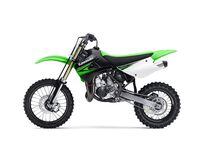
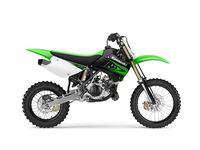
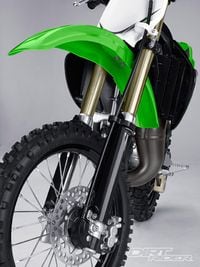
Kawasaki tuned the 2010 KX250F with the same basic upgrades used on the 450: steering stem, swingarm, linkage and suspension settings. In spite of the fact that the 450 is Kayaba-equipped and the 250F uses Showa components, the 250 also got spring rate and damping upgrades. The same is true of the engine. It gained a piston with the bridged-box bottom. This piston is lighter and stronger with a shorter skirt and shorter piston pin. Unlike the 450, the 250 piston features a revised crown to improve combustion. The cylinder height was raised maintain the 13.2:1 compression ratio. Opposite from the 450, the 250 boosts bottom power with a longer head pipe and shorter mid-section on the more durable stainless steel exhaust pipe.The 250F engine received other refinements for 2010, such as electrofusion treatment on the cylinder bore, revised oil pump rotors and a wider big-end bearing to increase engine life. Transmission durability was addressed with larger dogs on the third and fourth input gears and eliminating a circlip and washer and changing the shape of the second input gear. New crankcases are stronger and thicker with more material around the engine mount holes.Cosmetically the 250F gets a thicker fender, and lighter black wheels. The new radiators do require a new shroud design as well.The KX85 looks more radically different than its larger four-stroke siblings, but it didn't really get any mechanical changes. It does get a new look, though, with a black frame and wheels, lime green body panels, black shrouds and aggressive graphics.



/cloudfront-us-east-1.images.arcpublishing.com/octane/W5Y6FA2ALBGUBB4CF4TLKGGGX4.jpg)
/cloudfront-us-east-1.images.arcpublishing.com/octane/X237GYIQSNDRRJKGUFZB6JI62I.jpg)
/cloudfront-us-east-1.images.arcpublishing.com/octane/LZCKRNRZFJCDBERJZRZ7OD2YSQ.JPG)
/cloudfront-us-east-1.images.arcpublishing.com/octane/74NGPXXTXJFHVEUC4LCKB4B5YI.jpg)
/cloudfront-us-east-1.images.arcpublishing.com/octane/3BU6HTISE5FMLPVQLLPZ5BOTYY.jpg)
/cloudfront-us-east-1.images.arcpublishing.com/octane/GXUL6KCPBVEKDAVSKMN5MC4CMA.jpg)
/cloudfront-us-east-1.images.arcpublishing.com/octane/WBOGHOZLU5BKRLSCVCGKOVVY34.jpg)
/cloudfront-us-east-1.images.arcpublishing.com/octane/OJ5NCD4CE5DO7FPSOXULAXAWQE.jpg)
/cloudfront-us-east-1.images.arcpublishing.com/octane/S6VCF2Y7ZZDTTII2TUKZBZ73DM.jpg)
/cloudfront-us-east-1.images.arcpublishing.com/octane/4HRBOLM5G5BYDLVR4BOSHU4F3Q.jpg)
/cloudfront-us-east-1.images.arcpublishing.com/octane/PCXWZ5GQLRFFPJ7M7UGTETJEXQ.jpg)
/cloudfront-us-east-1.images.arcpublishing.com/octane/Q7KM7SH27VBIRMZ3XAIUHOWCTU.jpg)
/cloudfront-us-east-1.images.arcpublishing.com/octane/QBCJYVX6GBFRJOF67CQTOQWJRU.jpg)
/cloudfront-us-east-1.images.arcpublishing.com/octane/U6WTHXX6FZG5VMXN2X5X4JPV2M.jpg)
/cloudfront-us-east-1.images.arcpublishing.com/octane/U2L5VUGESJCYRGGIYVBTKAW5LY.jpg)
/cloudfront-us-east-1.images.arcpublishing.com/octane/SDPXS7Q2CVGRHI7TNZAUMHQVRU.jpg)
/cloudfront-us-east-1.images.arcpublishing.com/octane/4WKWAMC6PJBYXMGEOT6M3324K4.jpg)
/cloudfront-us-east-1.images.arcpublishing.com/octane/MUHABH5BPZCCDGBH3LMD6R63KA.jpg)
/cloudfront-us-east-1.images.arcpublishing.com/octane/DFFWUKLLEJAFBNZYSZMVZ3ZDGU.jpg)
/cloudfront-us-east-1.images.arcpublishing.com/octane/PYWSKZ2A5FAGLG5NMGFO7ZDVVY.jpg)
/cloudfront-us-east-1.images.arcpublishing.com/octane/IDV5JZQ5MVEFVN7VWEHUTY3TF4.jpg)
/cloudfront-us-east-1.images.arcpublishing.com/octane/TEEQ6FQCK5G5JNWFA743XPQ7PU.jpg)
/cloudfront-us-east-1.images.arcpublishing.com/octane/S4KLUEUZHZAITFWF3PUKKB7M7Q.jpg)
/cloudfront-us-east-1.images.arcpublishing.com/octane/5EEWHROAHNFQXIKLZLZFGI63YE.jpg)