Story by Marty Estes | Photos by Marty Estes and Adam Booth

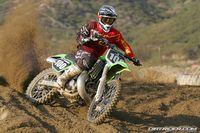
Chris Green grabs a handful aboard the rebuilt Kawasaki KX500.
We set out to re-build a KX500 to see how good it can be with more modern parts, and also how it stacks up against a modern 450. Ron Lechien even came out to ride the bike a few times and gave us his opinion. If you haven’t seen the print story, head to the newsstand in late July and pick up the September 2012 issue!
We started with a neglected 1996 KX500, purchased from a friend for $500. It had been ridden hard and put away wet, but appeared to be mostly “beginner crashed”, not ridden into the ground by a fast rider at any point. Still, it needed attention. The biggest problem area was the frame, which needed a lot of work pre-powdercoat due to loose and broken motor mounts. 500s produce an enormous amount of vibration, and bolts loosening and falling out are a common occurrence. If you’re not vigilant in checking them (with Loctite and a torque wrench in hand), problems will occur. The previous owner(s) put hours on this bike with a loose motor and around every mounting point (except for the swingarm) there were vibration-caused cracks to repair. So lesson number one when buying a used 500 (or any bike for that matter) – bring a flashlight and look very closely at the entire frame. Remove the seat and tank if you have to!
In the end, the restoration was very expensive. Looking at it from an “I want to make an old bike better than a new one”, it doesn’t make much sense. I was restoring (or saving) this old KX500 to bring it back to its full glory. It’s not worth anywhere near the sum of the parts that went into it, but the reality is that this was a “love of the sport” project. The big KX500 is a bit cranky at the track, and takes work to ride fast, but the bike is beautiful and totally unique. At the track, those who remember riding or racing open bikes search you out, and its great just talking about motocross. The 500 used to be the pinnacle of the sport, and it’s really fun to own and ride one.
Below is a summary of the teardown and build, with details on the parts used.
A 1996 KX500, tired but not broken. A desert beater.
Right-hand side. It looks like a pretty solid bike but beneath, there are problems.
Teardown begins: Off goes the hammered exhaust. Battered, cracked and leaking, there’s no saving this piece. Check out the exhaust mount. Turns out every exhaust mount is custom.
And here’s why. There’s very little holding the motor in place so that exhaust (and everything else) has been taking a beating from the huge motor. Hmmm….
This is the top-most exhaust mount – a very common problem area on this bike.
Yuck. Every motor mount is loose except for rear-most (swingarm pivot). Three of the four front motor mount bolts are gone; one is broken off in the studs and another is stripped. The only bolt remaining is a hardware store variety and it’s loose. Notice the custom weld job on the forward pipe mount. What did I get myself into?
Rims both have big dents in them and seized spokes. Front brake rotor is bent.
Subframe is bent. Left footpeg is from another bike and doesn’t fit correctly
Not sure how the crossbar of these vintage Renthals was bent but I hope it wasn’t from somebody’s chest! Desert tank needs to go as this bike will be used for motocross.
She runs but feels weak. Jetting is waaay off. Suspension is abysmal.
1996 was the year of the purple and green color scheme. The purple spring is the stocker and the shock doesn’t have much damping. The under-sprung, under-damped shock makes for a wild ride. The forks weren’t leaking but they are absolute jackhammers. The too-soft and springy rear end coupled with harsh forks makes it very difficult to ride fast (or enjoy).
Rear swingarm is functional but looks bad due to the paint on-top of aluminum.
16 year old brake fluid. Yuck.
Radiators are decent enough to keep. One tab is broken off but there are two others holding it well enough to forego replacing them.
As we take the motor out of the frame, we see the damage that the loose engine has done. Around every motor mount, there are cracks that need to be welded. Thankfully I know a few great welders including Dave, my brother-in-law shown here.
An entire new steel sleeve was fabricated by Dirt Rider shop guy extraordinaire Michael Candreia and welded in place. Here we are lining it up to weld. Also, notice the lower exhaust mount, which has been fixed and tapped.
A lot of work went into the frame to repair the damage vibration caused. This is where the head stay connects to the frame. After everything was done, it was time to send the frame to Andrews Powdercoating. I went with semi-gloss black powdercoat and the end result was beautiful.
Meanwhile, as we pull the top end off, we notice two things: It’s been ported by somebody and someone put a thicker head gasket on. Doesn’t make much sense to try to make it faster and mellow it out simultaneously but what do I know? Maybe it was done by two different owners. The thicker head-gasket mod was common for riders looking to mellow out the 500 hit.
Given my druthers, I wanted a stock cylinder to start with rather than one ported by persons unknown. Luckily Karel Kramer knew someone who has a spare stock KX500 cylinder. Good news: It’s from a low hour bike. Bad News: it’s got a piston and half a rod stuck in it from some catastrophic moment in time. Notice the damage to the skirt and gasket surface.
We send the cylinder off to Powerseal who assure us it’s “no problem”. What they return is a work of art.
A new Wiseco piston and rings are installed, with Cometic gaskets throughout the motor and an Autolite XP Iridium plug.
The clutch is replaced at the same time, with fiber plates and springs by EBC. Basket was in good shape as you can see.
A Pro Circuit Platinum pipe and 304 silencer replaced the system that came off the bike, with new rubber, Moose pipe springs, new copper crush washer and a bit of high-temp silicone. 100% drool free!
Shift lever by Driven Racing replaced the loose/stripped stock shifter. The Boyesen Factory Racing Ignition cover harkens back to the glory days of the 2stroke nationals and replaced the tired looking stock cover. A Boyesen Rad Valve replaced the cracked/weathered stock reed valve rubber. The crank seals were toast and sucking oil through the clutch-side seal as indicated by the clouds of smoke, poor jetting and disappearing trans fluid. An All Balls crank bearing/seal kit was fitted.
The wheels were out of round, with big dents front and rear. Also, many of the spokes had seized up. I replaced them (using the stock hubs) with Excel A60 front/rear wheels with spoke sets. Although black wheels are harder to maintain, I couldn’t resist. I ran Michelin Starcross MH3 tires, Vortex sprockets (stock gearing), an RK chain and BRP chain guide.
I had the front forks off of a 1998 model lying around, which were used instead of the 1996 43mm forks that came on the bike. This was a straightforward swap, benefit being more modern and rigid 46mm forks. All that was needed was different upper and lower triple clamps. BRP is the only company that I could find that still makes a complete set of new triple clamps for this bike, and they look great.
Pro Circuit revalved the re-sprung the forks and shock, which for a 220-pound Intermediate was expensive, but mandatory. The difference in this area, compared to before, is amazing.
I have always been a big fan of Fasst Company’s Flexx handlebars particularly for a bike with older suspension components. On square edged bumps or when you make a make a mistake and land had off a jump, they really save your wrists and help reduce general fatigue. I used new Motion Pro cables and Tag slim grips. The front brake on older KX’s has always been a weak point, with a mushy feel at the lever and not enough bite. I was determined to replace the stock master cylinder with something off a newer bike. After some research, I determined that YZ master cylinders generally use the same routing and sure enough, the ’07 YZ450F master cylinder I found on eBay for $30 was a perfect fit. Combined with an ARC brake lever and Spiegler front lines, the feel at the lever was significantly better.
To complement the brake improvements at the lever and line, I installed an oversized front rotor kit from EBC. The combined result is a dramatic improvement in stopping power; not quite on par with a modern bike but infinitely better than what we started with.
The bike came only with a desert tank and for the intended use (motocross) this was not ideal. Clarke Manufacturing has a full line of tanks, both oversized and stock. I wanted to keep the desert tank for desert riding. A Pingel petcock was used, and the stock petcock stayed on the desert tank for more convenient tank swaps.
Every bearing on the bike was replaced using a mix of All Balls and Moose bearing kits. All Balls provided the steering bearing/seal and linkage kit, while Moose for the swingarm, wheel bearing and wheel spacer.
The stock seat foam was worn out, so I replaced with Guts Racing foam with a tall/step kit and cover. I have used the step kit with success on newer KTMs but compared to those, the KX has a dished seat which tends to force you to sit in the middle of the bike. Sliding forward and staying forward is a challenge, and just general moving around the bike is difficult compared to newer, flatter seats. The step sort of “pinned you” in the middle of the bike even more, so I ended up taking it back off and running the seat in its regular configuration. The step cover worked with a little trimming.
Works Connection provided a lot of the detail parts that make the bike stand out – frame guards and skid plate help protect the frame, rear caliper guard, and other Works Connection parts used include the fuel vent cap, fork bleeder valves, oil fill plug and a trick looking brake cover for the newer YZ master cylinder.
Every bearing on the bike was replaced using a mix of All Balls and Moose bearing kits. All Balls provided the steering bearing/seal and linkage kit, while Moose for the swingarm, wheel bearing and wheel spacer.
Moose also provided detail pieces like the chain rollers, sprocket bolts, front brake pins and throttle tube.
The stock subframe was bent, and replaced by the aluminum AC Racing unit which lined up perfectly. IMS footpegs replace the mis-matched and crash-damaged set that came on the bike.