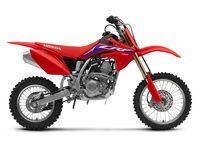
So the CRF250X has the pedigree and the credentials, but does it have the goods? To find out, we began by negotiating a test loop in Carefree, Arizona–where Honda introduced the bike to the U.S. press–on one of Chris Haines’ Baja Off-Road Tour Honda XR400Rs. Since we are very well acquainted with the XR400R and like it for technical trails, it was an excellent benchmark with which to compare the CRF250X. After that we hopped on the 49-state-spec machine, which would ultimately be our long-term test unit. Right away we applauded the starting–electric or kick, it is pretty foolproof and effortless. The riding position is smooth, bordering on luxurious, with the standard Renthal handlebar and fabulous seat. After the usual lever adjustments and fine-tuning, we hit the trail. The loop consisted of well-established decomposed granite, single-track trails with very little traction, some rough sections and an unending gauntlet of punishment for exiting the trail or forgetting to watch your toes. Plunging through the local bushes and skirting the chunks of not-yet-decomposed granite was anything but carefree.
The X was nimble on the trail, effortlessly threading through sections where the XR400R felt a bit truckish. We also noted the narrower CRF250X had comfortably more clearance vertically and between trailside foot blasters. The X would clean gaps that had the XR dragging hardware. The X also has a much-lighter feel, and its riding position is flatter, more oriented to aggressive, stand-up riding. It lacks the torquey feel of the uncorked, Pro Circuit-piped XR400R but seemed to accelerate with the same verve if we kept the rpm well up. Perhaps if the traction had been stickier the 400 would have been more impressive. The best XR400R we have dynoed had a bit more than 33 horsepower, so the lighter CRF-X with something in the neighborhood of 30 ponies (uncorked) should be close in terms of absolute engine performance. Of course, the X requires a lot more tap dancing on the shift lever, an intimate relationship with the clutch lever and an ear impervious to the 13,000-rpm soprano the tiny dynamo shrills. The XR400R generates equivalent thrust with relative ease. Compared with other 250cc four-strokes, though, the X is no more and perhaps even less frenetic. The engine pulls well from extremely low rpm, gains oomph in the middle rpm range then, like other modern 250cc four-strokes, revs to the moon while making impressive high-rpm pull.The X also handled G-load impacts and a series of whoops better. Its quick-revving response, light feel, superior travel and suspension components and robust frame all contribute to a more-aggressive handling ethic. The vastly more-cutting-edge chassis is more responsive to correct setup and less forgiving of inattention or riders outside the design envelope in size or weight. Race sag and fork-tube height changes have a definite effect on steering accuracy and overall chassis stability. Even with the modified linkage, the softer springs of the X (compared with the CRF-R) mean its power and suspension are best suited to lighter riders. We had 200-pounders aboard with little drama but feel confident that stiffer coils would have accommodated those riders better.As is, the suspension is plush but still offers excellent control and bottoming resistance. Honda claimed it wanted to avoid a single-purpose suspension setup and aimed at an overall balance encapsulating Eastern compliance and Western pounding. We know the X handles anything the West has to offer, and our best efforts duplicating Eastern conditions gives us faith it will also perform in the East.After riding the 49-state model, we did the test loop again, switching between the California-model clean machine and the 49-state stealth fighter multiple times. If anything the California model was a little beefier off-idle than the 49er and is perhaps the smallest bit softer in the middle-rpm ranges. The difference is small enough that opinions were mixed. Finally, we took a spin on the bike with closed-course modifications. There is no question the full-power machine pulled harder in the upper half of the powerband, but after half a day with the quiet bikes, the blatt of the exhaust was annoying and almost embarrassing, though the power was welcome. The off-idle roll-on suffered a bit in trade. The stocker will respond smoothly to throttle in too tall a gear, but the open airbox, aggressive cam and larger headpipe allowed the engine to stumble when the throttle was whacked open at too low an rpm.Brilliant, But …
Every rider who gave the CRF250X a shot was impressed with the overall competence and fine design of the machine. It is amazingly good, especially in completely stock, restricted form. That makes it a brilliant little four-stroke, off-road bike. Still, it is a four-stroke 250. For trail riding, we’d recommend the bike to any rider anywhere. For racing, the same is true for riders who have the option of a 250cc four-stroke class with their racing organization. Vets, seniors or pros who all run in the same class regardless of the bike they ride will face a tougher decision. Scott Summers and Randy Hawkins both have acknowledged that they can turn lap times as fast as any bike on a 250cc four-stroke, but they can’t get through traffic in the woods. It is too tough to pass a two-stroke or a larger four-stroke on a short, straight section. Nevertheless, we are sure Honda will sell every unit it can make, and it deserves to. The CRF250X is a flawless trail companion and an able racer with the potential to be a real weapon in the right hands. Bike of the Year, indeed.
FMF Dyno Test
The CRF250X was one of those machines that we felt really needed to see a dyno. The stock machine runs very well and is a quiet 89 decibels. The closed-course-modified bike ran better but was an obnoxious 100 decibels. We had FMF run the dyno tests, and the stock bike made about 27 horsepower at a fairly low rpm for a 250cc four-stroke. A second bike with the CRF250R header pipe and cam, the opened airbox, the muffler baffle removed and swapped wires in the ignition made 30 horsepower but lost power everywhere down low. Installing the 92-decibel FMF Q muffler made the Honda run better than the loud bike everywhere in the rpm range, and it was still well within California and Michigan sound limits. We need to do more testing, but it looks as if most riders would be happiest, even for closed-course competition, with the stock cam and header but with a good aftermarket quiet pipe. We’ve tried both the FMF Q and the Pro Circuit 496. We don’t have comparative dyno charts for the Pro Circuit, but both worked well when riding. The PC measured at 93 decibels.Opinions
Visually, the Honda CRF250X is a very clean-looking and well-designed bike. The attention to detail you’d expect from a Honda is evident down to the quick-adjust clutch perch. Being used to a KTM 300 E/XC two-stroke with roughly twice the horsepower, I wasn’t sure how comfortable I’d be riding the bike.That doubt evaporated more quickly than water in the Arizona desert. The bike fit me very well, and moving around was no problem at all. The power came on smoothly from the bottom, but twist the throttle and this bike moves! Just make sure you are in the right gear and ride the bike like a smallish two-stroke when you want to make the best trail speed. I was most impressed with the suspension. Both ends felt smooth, the chassis was stable and I never got close to bottoming, even when hitting rock ledges at speed. Whoops? No problem. Just twist the throttle and go. The bike turned very well on tight trails, but the decomposed-granite desert floor did persuade the stock front tire to push at times. Overall, the X is a very nice bike and just what we have been waiting for from Honda. My advice is to buy one for the wife, but don’t be surprised when you find yourself doing dishes to get her to let you take it out!
Don Hurd/5’8″/160 lb/B riderThe CRF250X was a blast to ride and a lot more fun than Yamaha’s WR250F. I own a CRF250R, and it is faster, but on the slippery trails in Arizona, the X motor was awesome. The power is very smooth, and at least on the hard ground we encountered, the Honda would climb any hill. The CRF250X has torquey bottom power, so it accelerated strongly and pulled well from gear to gear. Even though it is plush, totally equipped and nearly silent, the X feels race-capable and competitive. When flicking from side to side through successive turns and switchbacks it tracked very well. The off-road-tuned Showa suspension absorbs big G-outs, and I got excited every time I saw whoops, because I would floor it through them as fast as possible without the bike swapping at all. The X is easy to maneuver and nimble, but the trail in Carefree uncovered another trait: The bike is narrow at the footpegs. It would slip between rocks I thought it would hit. I’m not sure about in deep sand or mud, but anywhere else I would love to ride this bike.
Tyler Keefe/5’9″/160 lb/IntermediateI’ve always had fun on small four-strokes, and I love to play-ride them. I’m even happy to race them as long as the riding surface is hard or rocky. Honda has done a whale of a job on this little bike, though. It’s fun in bone-stock condition. I’d ride it anywhere back East. In fact, the mountainous, sandy high desert is the only place that would give me pause. Still, this CRF250X is fun enough to make me wish I were a little shorter. Maybe I’ll even go on a diet! What I won’t do is give this baby up without a fight.
Karel Kramer/6’1″/200 lb/B rider
Want to see Dirt Rider’s other favorite bikes of 2004? Click to see all the runners-up for the Bike of the Year.
The Best Bikes of 2004